Photo of Cortney Morgan

Cortney Morgan

An experienced attorney in the area of international trade and supply chain issues, Cortney advises foreign and domestic clients on all aspects of international trade regulation, planning and compliance, including import (customs), export controls, economic sanctions, embargoes, international trade agreements and preference programs.

In an October 21, 2021 interim final rule (“IFR”), the Bureau of Industry and Security (“BIS”) published long-awaited “cybersecurity items” controls in Categories 4 (Computers) and 5, Pt. 1 (Telecommunications) of the Commerce Control List (“CCL”) and followed the IFR up on November 12, 2021 with relevant FAQs.  The IFR will impose new export controls on certain “cybersecurity items” that relate to “intrusion software” or “IP network communications surveillance.” The IFR, originally scheduled to become effective on January 19, 2022, will now become effective on March 7, 2022.  In the January 12, 2022 notice announcing the delay, BIS stated it “may consider some modifications for the final rule” and indicated it would “provide the public with additional guidance.”  Below we describe the IFR as it currently stands.  We will update readers when BIS implements any additional edits to the IFR and/or updates its guidance.

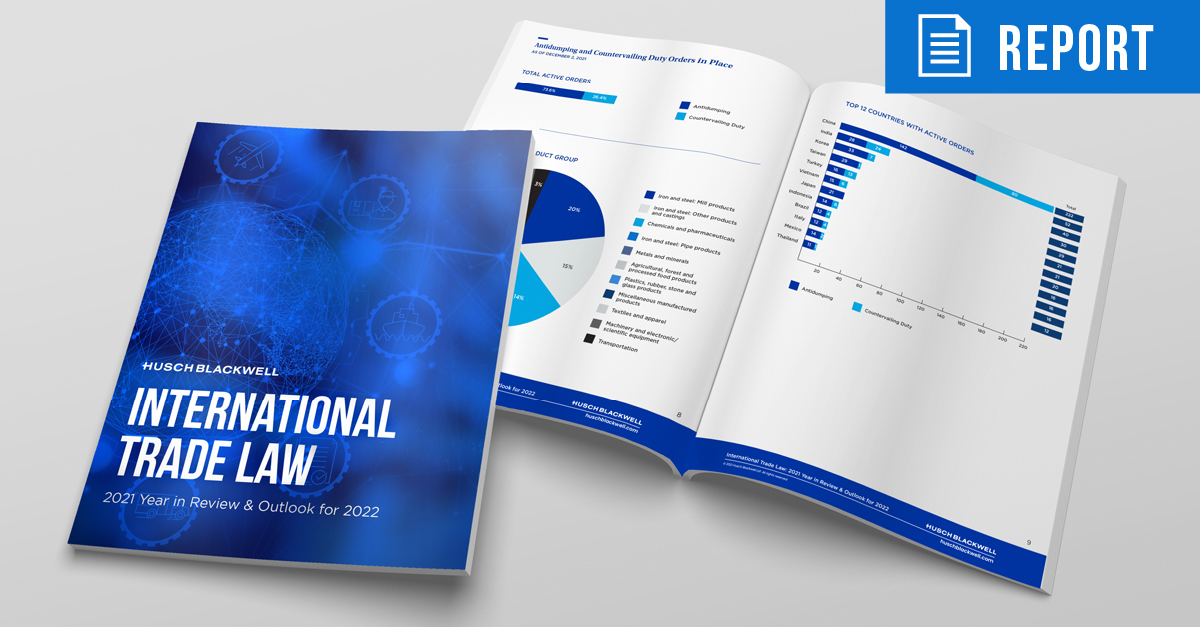
Husch Blackwell’s third-annual international trade law year-in-review report provides a detailed look at how 2021 played out and takes a peek at how 2022 might develop. As companies begin to strategize on what a second year of the Biden administration will bring, we hope the framework presented in our report will help your business maximize potential cost savings and minimize potential risks as enforcement activity continues to rise and supply chains remain under pressure well into the coming year.

As previously reported, in February 2021, President Biden issued Executive Order 14017 (“EO 14017”), which instructed various government agencies to review the current supply chain risks for critical sectors and subsectors of the Information and Communications Technology (“ICT”) industrial base and provide the executive branch with reports of identified risks. In order to comply with EO 14017, the Bureau of Industry and Security (“BIS”) recently announced that it will host a virtual forum soliciting recommendations from the public on how to strengthen the resiliency of the ICT industrial base. The ICT industrial base consists of:

On October 5, 2021, the U.S. Department of Commerce’s Bureau of Industry and Security (“BIS”) published a final rule in the Federal Register that places new controls on software and technology that can potentially be used for manufacturing biological weapons. The rule comes after a decision in May 2021 by the forty-three (43) participant countries

The Department of Commerce’s (“Commerce”) Bureau of Industry & Security (“BIS”) recently issued requests for comment on risks to the information communications and technology (“ICT”) and semiconductor supply chains.  These comments are being requested as part of the U.S. government’s broader review of supply chain vulnerabilities (see here, here, and here).

ICT

On August 20, 2021, U.S. Customs and Border Protection (“CBP”) issued Cargo Systems Messaging Service (“CSMS”) message # 49132200 addressing documentation requirements for import shipments valued over $2,500 to qualify for the duty-free “U.S. and Foreign Origin Goods Returned” preferential tariff provision under HTSUS Subheading 9801.00.10. 

The Petitioners representing the U.S. domestic industry filed new petitions with the U.S. Department of Commerce (“Commerce”) against imports from three countries, Thailand, Vietnam, and Malaysia, alleging that certain Chinese producers are diverting Chinese-origin components through Thailand to undergo minor processing to complete Crystalline Silicon Photovoltaic (“CSPV”) cells and modules subject to the Orders and subsequently to export the merchandise to the United States to avoid AD/CVD duties.  The companies that were named in the circumvention submissions were:

During the past month, the U.S. Department of Treasury’s Office of Foreign Assets Control (“OFAC”) has issued three separate rounds of Specially Designated Nationals & Blocked Persons List (“SDN List”) designations in order to support protests in Cuba that began on July 11th.  Further, OFAC and the U.S. Department of Commerce’s Bureau of Industry and

On August 9, 2021, President Biden issued Executive Order 14038 (the “EO”) which expanded the scope of the national emergency previously declared in EO 13405 of June 16, 2006.  The EO imposes additional sanctions in response to conduct by the Government of Belarus (“GoB”) and the President Alyaksandr Lukashenka regime which the Biden Administration described

As part of the U.S. Government’s ongoing response to the military coup in Burma (Myanmar), the Department of Commerce’s Bureau of Industry and Security (“BIS”) added four entities to the Entity List effective July 6, 2021 and the Department of Treasury’s Office of Foreign Assets Control (“OFAC”) added twenty-two individuals to the Specially Designated Nationals