International Trade Remedies

U.S. Customs and Border Protection (“CBP”) issued a Federal Register notice that it is now ready to execute “executing enhanced enforcement procedures.”  CBP has indicated that it will start verifying importer of record information provided by each importer on CBP Form 5106, and importers of record have until September 18, 2026, to correct any errors

The Trump Administration has officially reduced tariffs on patented pharmaceuticals and associated pharmaceutical ingredients imported from the United Kingdom (UK) from 10% to 0%. This change, effective July 31, 2026, is the result of an agreement between the United States and the UK, which created a carve out for UK origin pharmaceutical products from the recent national security tariffs imposed on patented pharmaceuticals pursuant to Section 232 of the Trade Expansion Act of 1962 (Section 232).

On August 4, 2026 the Bureau of Industry and Security (BIS) published a notice seeking public comments on expanding tariffs applicable to certain steel, aluminum and copper derivative products under Section 232 of the Trade Expansion Act of 1962 (Section 232) to fourteen (14) additional derivative products.

The list of products proposed to be subject

On August 3, 2026, the state attorney generals of twenty-five states (25) co-led by State of Oregon, Arizona and California filed a complaint in the Court of International Trade (CIT) challenging tariffs imposed under Section 301 of the Trade Act of 1974 (Section 301) to address forced labor. The complaint alleges that Section 301 forced labor tariffs are ultra vires, arbitrary, capricious and contrary to law.

This complaint by the 25 state attorney generals challenging the legality of the Section 301 forced labor tariffs, joins other lawsuits pending before the CIT that were filed by small business plaintiffs, Burlap and Barrel, Inc. and Collective Horology LLC.

On July 31, 2026, President Trump issued proclamation “To Facilitate Positive Adjustment to Competition From Imports of Quartz Surface Products,” introducing a tariff-rate quota (“TRQ”) that will go into effect on August 15, 2026 on imports of certain quartz surface products under Section 203 of the Trade Act. The action follows a recommendation from the International Trade Commission in May 2026, which found that increased import volumes of quartz are harming the domestic quartz industry.

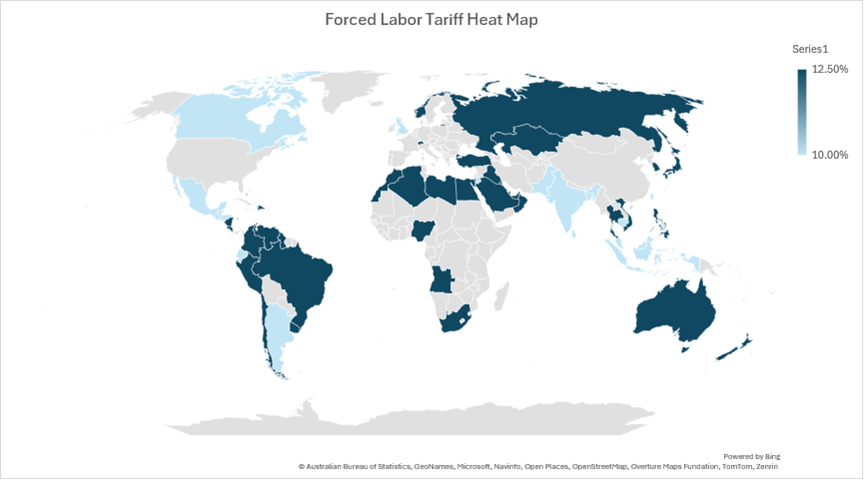
The Office of the United States Trade Representative (USTR) has announced the imposition of new Section 301 tariffs under the Trade Act of 1974. Following investigations into global forced labor policies, the USTR has determined that 60 economies have failed to adequately impose or enforce prohibitions on the importation of goods produced with forced labor. The tariffs take effect at 12:01 a.m. Eastern Time beginning July 24, 2026.

On June 2, 2026, the Office of the United States Trade Representative (“USTR”) announced a public comment period related to the development of a new government-to-government mechanism, a proposed U.S.-China “Board of Trade,” intended to provide an ongoing channel for managing aspects of bilateral trade between the United States and China.

In the latest developments regarding tariffs paid under the International Economic Emergency Powers Act (“IEEPA”), the U.S. Department of Justice (“DOJ”) has formally appealed the U.S. Court of International Trade’s (“CIT”) April 17, 2026, universal injunction ordering refunds to all importers to the U.S. Court of Appeals for the Federal Circuit (“Federal Circuit”).  The DOJ has

On June 2, 2026, the United States Trade Representative (“USTR”) proposed tariffs under Section 301 of the Trade Act of 1974 (“Section 301”) on imports from 60 countries for their failure to enforce prohibitions related to forced labor. The USTR found that these failures are unreasonable and burden U.S. commerce. The proposed tariffs range from 10% to 12.5%, though they do contain several carveouts.