January 2022

Today, the U.S. Department of Homeland Security (“DHS”) issued a request for comments to assist the Forced Labor Enforcement Task Force (“FLETF”) with implementation of the Uyghur Forced Labor Prevention Act (“UFLPA”).  The UFLPA, signed by President Biden on December 23, 2021, creates a rebuttable presumption that goods manufactured wholly or in part in the Xinjiang Uyghur Autonomous Region (“Xinjiang”) or produced by an entity on a number of lists to be produced, will be denied entry into the U.S. under section 307 of the Tariff Act of 1930 (19 U.S.C. 1307).  The UFLPA was passed in response to the alleged use of forced labor of Uyghurs, Kazakhs, Kyrgyz, Tibetans, and other persecuted groups in China.  Readers can learn more about the UFLPA and the rebuttable presumption, which goes into effect on June 21, 2022, in our previous post following the UFLPA’s enactment.

As tensions run high between Washington and Moscow over a possibly imminent Russian invasion of Ukraine, the U.S. Department of the Treasury’s Office of Foreign Assets Control (“OFAC”) designated today four (4) current and former Ukrainian officials under Executive Order (“EO”) 14024 dated April 15, 2021.  In a press release issued earlier today, OFAC asserted the Russian Federal Security Service (“FSB”) “recruit[s] Ukrainian citizens in key positions to gain access to sensitive information, threaten the sovereignty of Ukraine, and then leverage these Ukrainian officials to create instability in advance of a potential Russian invasion.”  OFAC also noted that Russian agents have sought to influence U.S. elections since at least 2016.

In an October 21, 2021 interim final rule (“IFR”), the Bureau of Industry and Security (“BIS”) published long-awaited “cybersecurity items” controls in Categories 4 (Computers) and 5, Pt. 1 (Telecommunications) of the Commerce Control List (“CCL”) and followed the IFR up on November 12, 2021 with relevant FAQs.  The IFR will impose new export controls on certain “cybersecurity items” that relate to “intrusion software” or “IP network communications surveillance.” The IFR, originally scheduled to become effective on January 19, 2022, will now become effective on March 7, 2022.  In the January 12, 2022 notice announcing the delay, BIS stated it “may consider some modifications for the final rule” and indicated it would “provide the public with additional guidance.”  Below we describe the IFR as it currently stands.  We will update readers when BIS implements any additional edits to the IFR and/or updates its guidance.

Last week a decision was released in a dispute between the US and Canada related to Canada’s dairy tariff-rate quotas (TRQ) under the United States-Mexico-Canada Agreement (USMCA). The dispute settlement panel found that certain Canadian restrictions on use of the TRQs are in violations of its obligations under the free trade agreement. Specifically, the Panel found that Canada has breached its USMCA Article 3.A.2.11(b) commitments by “reserving TRQ pools exclusively for the use of processors.”

In Husch Blackwell’s December 2021 Trade Law Newsletter, you’ll learn about the following updates in international trade and supply chain law:

  • President Biden issued a Proclamation to update the Harmonized Tariff Schedule and re-affirmed the changes to the section 232 tariffs that took effect Jan. 1
  • An update on U.S. Department of Commerce decisions

On January 3, 2022, the Department of Commerce (“Commerce”) announced in the Federal Register the opportunity to request an annual administrative review for products that are currently subject to antidumping and countervailing duties. The products and countries that have been listed in the Federal Register notice are the following:

AD

  • Belarus: Carbon and Alloy Steel

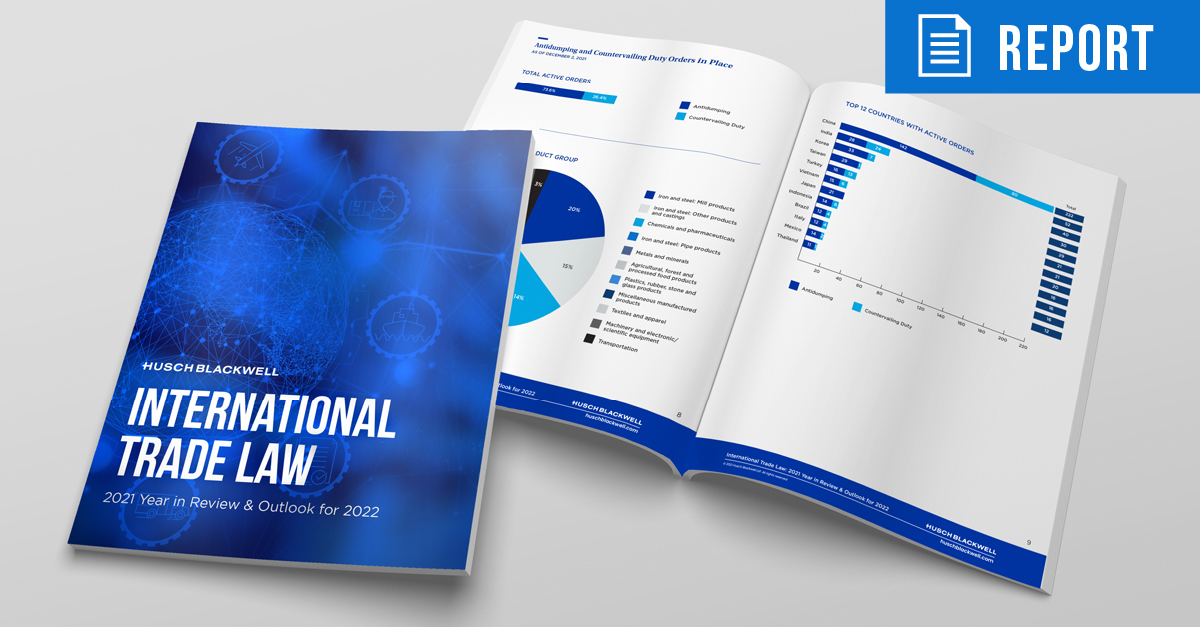
Husch Blackwell’s third-annual international trade law year-in-review report provides a detailed look at how 2021 played out and takes a peek at how 2022 might develop. As companies begin to strategize on what a second year of the Biden administration will bring, we hope the framework presented in our report will help your business maximize potential cost savings and minimize potential risks as enforcement activity continues to rise and supply chains remain under pressure well into the coming year.