Legislative & Judicial Updates

As of October 1, 2025, the U.S. Government has shut down as a result of the budget impasse in Congress. While essential services such as law enforcement remain operational, many departments have had to furlough staff and suspend non-critical functions.

For international trade-related operations, the impact varies by agency. Critical functions tied to national security—such

In March 2025, in a similar blog post to this one, Nithya Nagarajan and Robert Romashko forecasted that False Claims Act (“FCA”) enforcement would increase under the current tariff-focused trade policy regime. Sure enough, the Department of Justice (“DOJ”) recently announced two FCA resolutions involving allegations of failure to pay customs duties and evasion of antidumping and countervailing duties.

On April 24, 2024, President Biden signed into law the 21st Century Peace through Strength Act, Pub. L. No. 118-50, div. D. Part of the Act included a provision extending the statute of limitations for civil and criminal violations of the International Emergency Economic Powers Act (IEEPA) and the Trading with the Enemy Act (TWEA) from five years to 10 years. The new statute of limitations took effect on the date of the President’s signature.

Omaha-based partner Grant Leach appeared last week on an episode of The Justice Insiders podcast to discuss the ever-expanding set of requirements and restrictions placed on U.S. businesses in connection with trade law, including a key change in the statute of limitations—from five years to ten—in connection with the Office of Foreign Assets Control (OFAC)

In a September 6, 2023 opinion issued by Judge M. Miller Baker in three cases brought under the Court’s residual jurisdiction provision, 28 U.S.C. § 1581(i), the U.S. Court of International Trade (“CIT”) held that reliquidation is available as a remedy in Administrative Procedure Act (“APA”) cases.  At least in the short term, this decision creates

Check out the latest episode of The Justice Insiders—a podcast hosted by Husch Blackwell partner Gregg Sofer—where we explore the intersection of international trade law and government investigations and enforcement, particularly in connection with Russia.

I previously appeared on Gregg’s podcast during the first quarter of 2022, and we pick up that

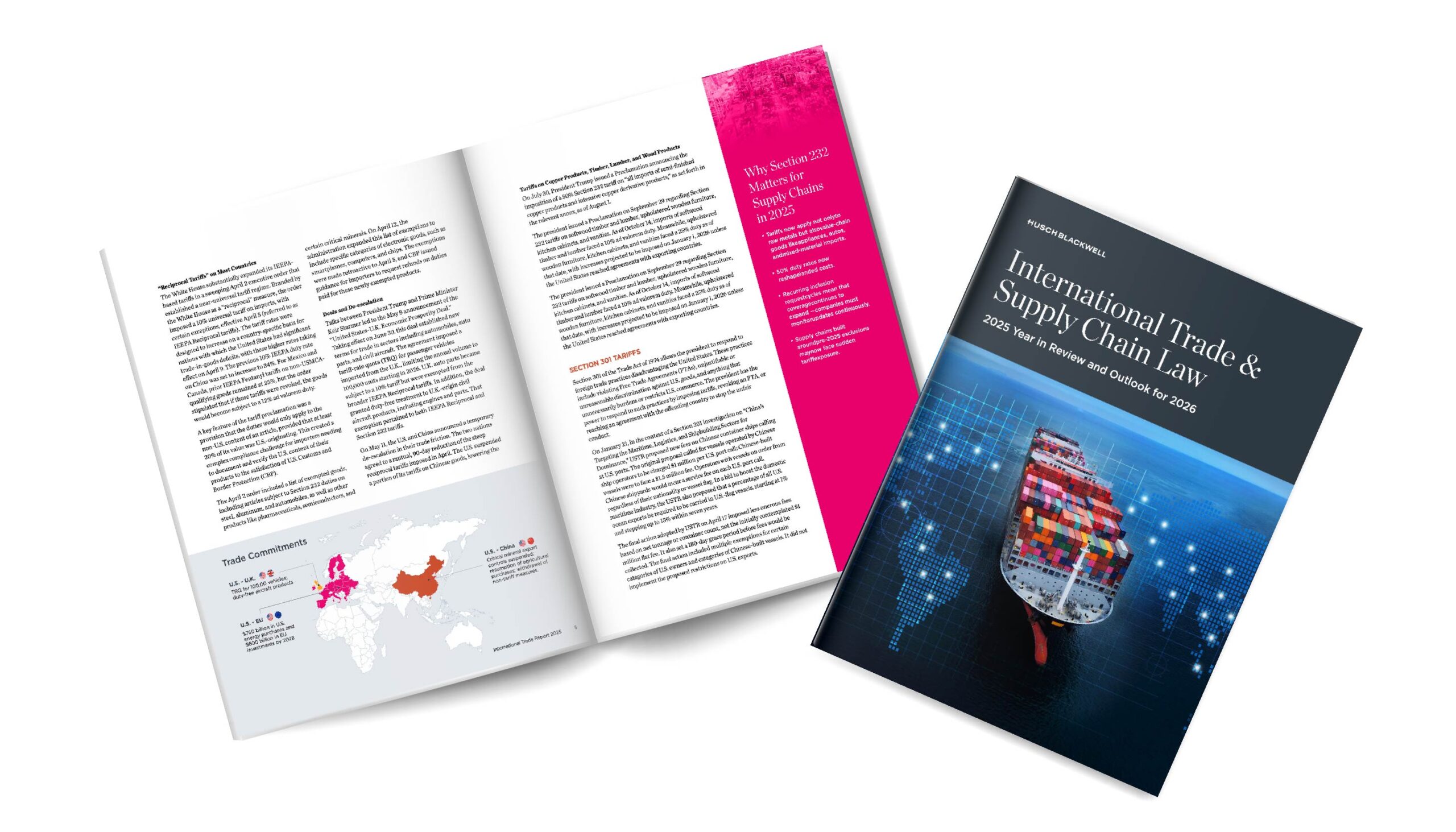
We are pleased to announce that our team’s fourth-annual international trade law year-in-review report was published just before the New Year. In it, we take a detailed look at how 2022 played out and explore how 2023 might develop. As companies continue to work through the challenges associated with supply chain dislocations, geopolitical turmoil, and

On August 23rd the U.S. Court of Appeals for the Federal Circuit (“Federal Circuit”) struck down federal regulations restricting refunds on export taxes and restricting beer and wine manufacturers greater tax refunds for duties paid on imports. In National Association of Manufacturers v. Department of the Treasury (see ruling here), the Federal Circuit

Court of International Trade

Summary of Decisions

19-52

On May 1, 2019, the CIT sustained Commerce’s remand redetermination results following a countervailing duty investigation for certain hot-rolled steel flat products from the Republic of Korea. The court reviewed two issues on remand, Commerce’s selection of the highest calculated AFA rate and Commerce’s corroboration. Concerning the first issued on the selection of the AFA rate, the CIT found that Plaintiff POSCO did not exhaust its administrative remedies. The second issue presented was whether or not the selected 1.05% AFA rate was corroborated based upon substantial evidence and whether Commerce’s selection of a non-de-minimis AFA rate was appropriate because it was a rate calculated for a cooperating Korean company in another countervailing duty proceeding for a similar program.

19-53

On May 2, 2019, in the case of garage door openers that were redesigned to avoid infringement on a registered patent, the CIT denied the ITC’s motion for a stay pending appeal based on the grounds that the ITC did not meet its burden for a stay. A stay of the preliminary injunction and all other proceedings in this matter was not warranted as: (1) the ITC has not demonstrated a “strong showing” of likelihood of success on the merits, (2) the ITC has not demonstrated that it will be irreparably injured absent a stay in this action, (3) the issuance of a stay would substantially injure another party, the Plaintiff, and (4) the public interest is neutral. For those reasons, the CIT denied the ITC’s motion for a stay.