
The U.S. Supreme Court recently heard oral arguments in Flowers Foods, Inc. v. Brock, No. 24-935, a case to determine whether a last-mile delivery driver who picks up products and delivers them within the same state qualifies as a “transportation worker engaged in interstate commerce” and is exempt from the Federal Arbitration Act (FAA)
A Temporary Waiver of the Jones Act May Be Coming in Response to the Middle East Conflict
To address disruption in the global energy flow resulting from the conflict with Iran, the White House is considering a temporary waiver of the Jones Act—the law requiring cargo moving between U.S. ports to be carried on U.S.-built vehicles. If this waiver goes into effect, it will have important implications for ocean shipping stakeholders.
To
The Implications of New Fuel Surcharges in Response to Shipping Disruptions in the Middle East
Several major ocean carriers have recently announced new Energy Fuel Surcharges (EFS) in response to sharply rising bunker fuel costs resulting from the latest geopolitical disruption in the Middle East.
Despite the sudden nature of the announcements, these surcharges will still need to comply with tariff and publishing requirements established by the U.S. Federal Maritime
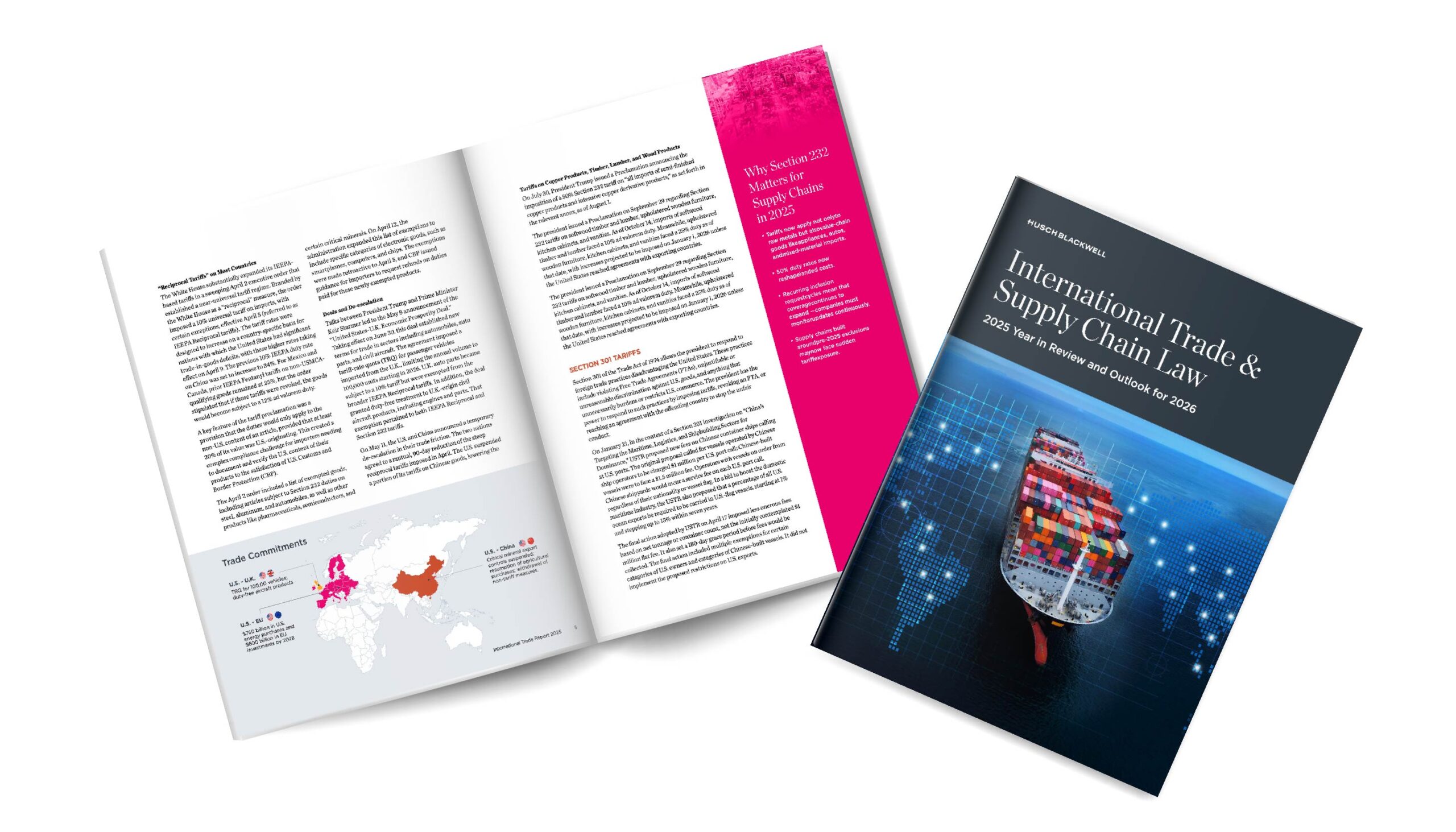
International Trade & Supply Chain Law: Download Our 2025 Year in Review & 2026 Outlook
- How
Petition Summary: Certain Freight Rail Couplers and Parts Thereof from the Czech Republic and the Republic of India

On July 23, 2025, the Coalition of Freight Coupler Producers (“Petitioners”), filed a petition for the imposition of antidumping duties on U.S. imports of Certain Freight Rail Couplers and Parts Thereof from the Czech Republic and the Republic of India and countervailing duties on the Republic of India.
SCOPE OF THE INVESTIGATION
The following language
Special Provisions Go Into Effect for UK Autos, Auto Parts and Civil Aircraft Products Under the United States – U.K. Economic Prosperity Deal
On June 30, 2025, the U.S. Department of Commerce published in the Federal Register a notice to modify the Harmonized Tariff Schedule of the United States (HTSUS) to conform with General Terms of the United States of America-United Kingdom Economic Prosperity Deal (Executive Order 14309) with respect to automobiles, automobile parts, civil aircraft

What Do Importers and Shippers Need to Know about the FMC’s New Rule on D&D Invoices?
On February 23, 2024, the Federal Maritime Commission (FMC) issued a Final Rule intended to add clarity to invoicing requirements outlined in the Ocean Shipping Reform Act of 2022 (OSRA 2022). In particular, the Final Rule provides minimum information for demurrage and detention (D&D) invoices and procedures for disputing charges. D&D invoices have created a host of issues for importers and shippers throughout the economy, especially as they relate to the lack of information provided on the invoices.
FMC Allows Rate Hikes for Carriers in Response to Red Sea Hostilities
- Many of the rate hikes represent almost a 100% increase in shipping rates
- The special permission is not only to increase the rates and charges, but these increases are effective immediately as they also waive the FMC’s required 30-day notice period for increasing rates
- Absent significant military or diplomatic action, our expectation is that these circumstances will not disappear quickly
The Federal Maritime Commission (FMC) has granted special permission to ocean carriers to immediately increase the rates on containers that are being rerouted around the Cape of Good Hope in Africa or are retaining feeder vessels for pickup of cargo at high-risk ports in the Red Sea due to increased hostilities. Since mid-November 2023, Houthi rebels based in Yemen have attacked Red Sea shipping bound for Israel or linked to Israeli ports. Reported security incidents have ranged from outright attacks, approaches, and business interruptions to mere sightings.
The Application of Force Majeure Provisions to Shipping Disputes

Force majeure contract provisions are potentially coming into play as Maersk, Hapag-Lloyd, and other ocean carriers divert ships around geopolitical trouble spots in the Red Sea.
Section 301 Exclusion Update
On December 26, 2023, the United States Trade Representative (“USTR”) announced that it will further extend 352 reinstated exclusions and 77 COVID-related exclusions to duties imposed on goods from China pursuant to Section 301 of the Trade Act of 1974 until May 31, 2024. USTR imposed Section 301 duties in four tranches or “lists,” and